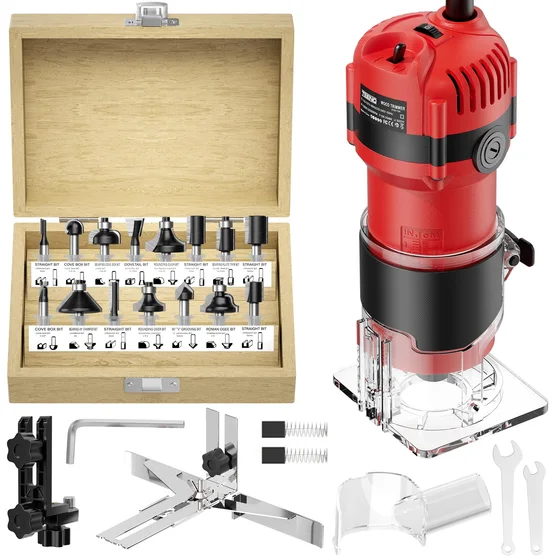
 Corded1.25 HP
Guide
Palm router or oscillating tool: what each one does
A router shapes edges. A multi-tool cuts and sands where nothing else fits. Here is which job goes to which tool, and how to set each one up.

Two tools
Shape or cut?
A palm router spins a bit at high speed and shapes the wood it touches. Round over a tabletop, chamfer a shelf, trim laminate flush, cut a shallow groove or a hinge recess. The 1.25 HP Palm Router does this with a 1.25 HP, 6.5 A motor and a six-speed dial.
An oscillating tool swings a blade back and forth a few degrees, thousands of times a minute. It plunges into a wall, cuts flush against a floor and sands into corners. The 20V Oscillating Tool runs from 8,500 to 21,000 OPM with a 4° swing.
Neither one replaces the other. If your project is mostly edges, get the router first. If it is mostly repairs and remodeling, get the multi-tool.
-
Corded1.25 HP
-
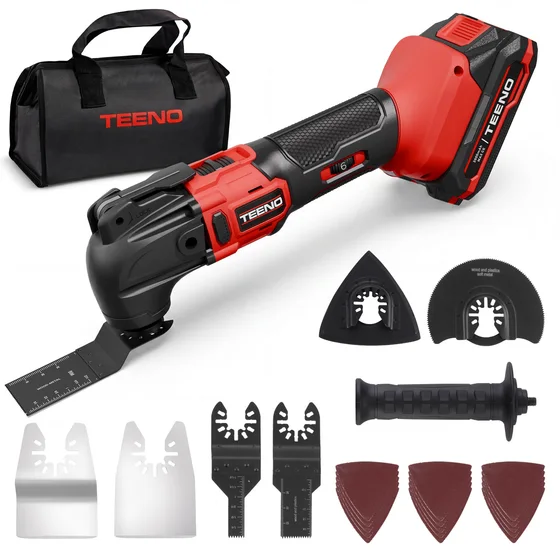 20Vup to 21,000 OPM
Router setup
Bits, collets and speed
- 1
Match the collet
Our router takes 1/4 in and 6 mm shanks, and both collets are in the kit. It does not take 1/2 in bits.
- 2
Set the depth
Use the scale on the clear base. Take deep cuts in two or three shallow passes.
- 3
Pick the speed
Lower speeds for large bits and hardwood, higher ones for small bits and softwood.
- 4
Feed direction
On an outside edge, move the router counterclockwise, so the bit pulls into the work.
Multi-tool blades
Which blade cuts what
- 1
Straight blade
Plunge cuts in wood and drywall, and flush cuts under door casing.
- 2
Segment blade
The round blade, for long straight cuts and grout lines.
- 3
Scraper
Old caulk, glue and vinyl off a floor.
- 4
Sanding pad
A triangle pad that reaches into corners. The kit has sanding sheets in mixed grits.
In the shop
Chips fly from both
A router throws chips, and a multi-tool throws dust and bits of whatever it cuts. OSHA’s rule for workplaces asks for eye protection that provides side protection when there is a hazard from flying objects.
OSHA, 29 CFR 1910.133 The same habit makes sense in a garage.
Hook up the dust hood on the router to a shop vac, and clamp small parts before you rout or cut them, so both hands stay on the tool.
Side by side
Palm router or oscillating tool
| Compared | Palm router | Oscillating tool |
|---|---|---|
| Power | Corded, 6.5 A, 1.25 HP | Cordless, 20 V |
| Speed | Six speeds | 8,500 to 21,000 OPM, six speeds |
| In the kit | 15 bits, two collets, guides | 26 blades, pads and sheets |
| Better choice when | You shape edges and cut grooves | You plunge-cut, flush-cut and sand corners |
Questions
Questions about routers and multi-tools
Can a palm router cut a dado for a shelf?
A shallow one, yes. With a straight bit from the 15-piece set, the 1.25 HP Palm Router cuts a dado in 2 or 3 passes. For deep dadoes, a full-size router does it in fewer.
Can an oscillating tool cut a hole in drywall for an outlet box?
Yes. A straight blade plunges into drywall, and the 20V Oscillating Tool has 6 speeds, so you can start slow on the mark.
Sources
- Eye and face protectionOSHA, 29 CFR 1910.133 · read October 20, 2026